🧠 What State Is Your Nervous System In? Understanding the Window of Tolerance
By Pierre Begrand,
Registered Professional Counsellor (RPC)
Pierre Begrand Counselling | Saskatoon, Saskatchewan
Have you ever wondered why some days everything seems to bother you, while other days you barely feel anything at all?
Maybe one day your mind is racing.
You're overthinking conversations, feeling anxious, becoming irritated easily, or struggling to relax.
Then, on another day, something completely different happens.
You feel exhausted. Unmotivated. Emotionally flat. You don't want to talk to anyone. Even small tasks feel difficult.
And sometimes, you feel good.
Your thinking is clearer. Your emotions feel manageable. You're present, connected, and able to handle life's challenges without becoming completely overwhelmed.
Why can the same person experience such different emotional states?
Part of the answer may lie in something called your window of tolerance.
Understanding this concept can change the way you relate to anxiety, emotional overwhelm, stress, exhaustion, and even your own behaviour.
Because sometimes, what we interpret as a problem with our personality is actually a change in how our mind and body are responding to stress.
Let's explore what that means.
🧠 What Is the Window of Tolerance?
The window of tolerance is a psychological framework associated with psychiatrist Dr. Daniel J. Siegel.
It describes the range of emotional and physiological activation within which we can generally think, feel, connect, and respond effectively to life's challenges.
Imagine your nervous system has a comfortable operating range.
Within that range, you can experience stress without being consumed by it.
You can feel sadness without becoming completely overwhelmed.
You can experience anger without automatically reacting.
You can face uncertainty while still having access to your ability to think, reflect, and make decisions.
But when stress becomes too intense, prolonged, or difficult to manage, you may move outside that comfortable range.
This can happen in two broad directions:
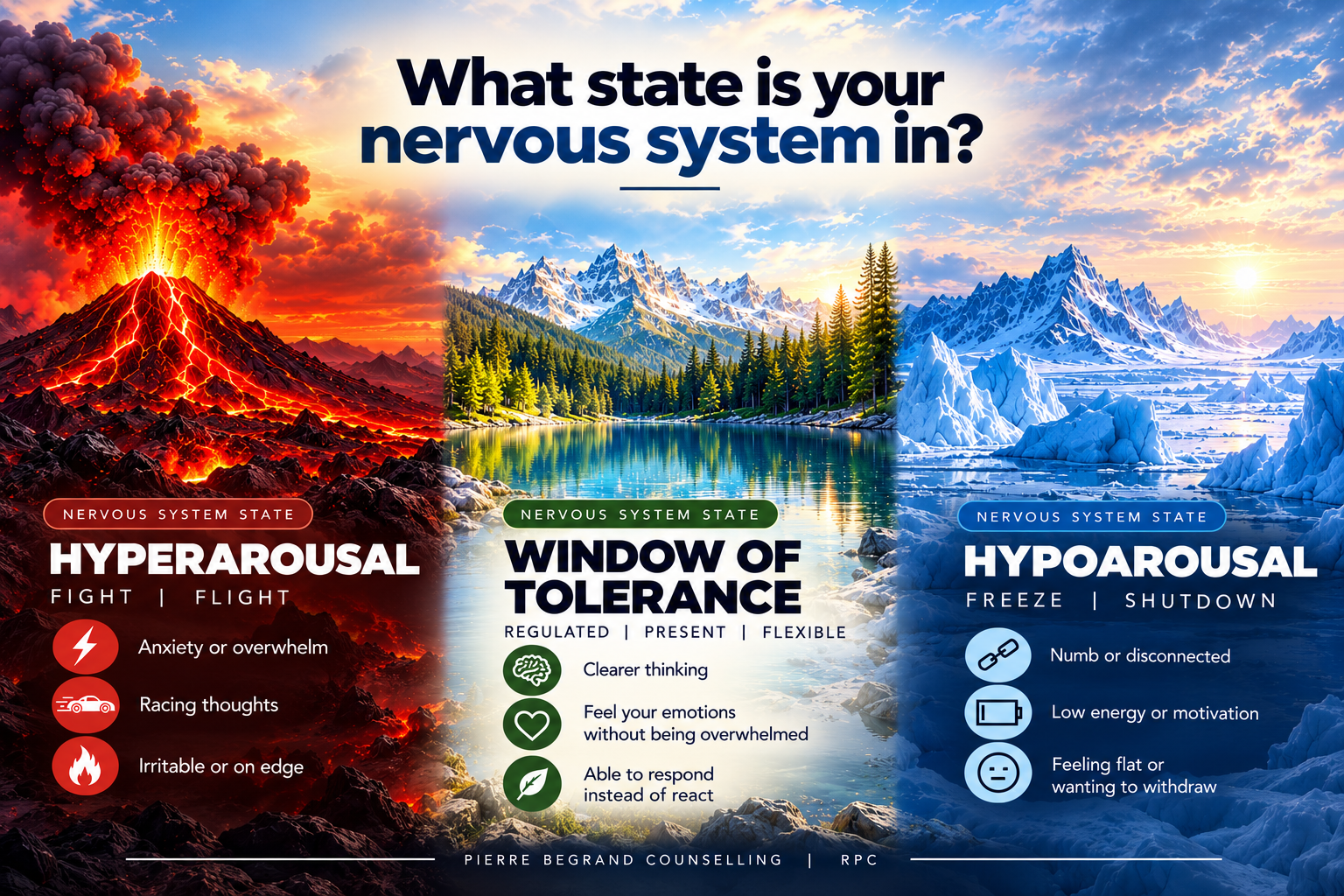
Hyperarousal: Your system becomes highly activated, anxious, overwhelmed, or on edge.
Hypoarousal: Your system becomes less responsive, emotionally numb, disconnected, or shut down.
Between these experiences is your window of tolerance — the zone where you have greater emotional flexibility.
These aren't three rigid categories or medical diagnoses. They're a helpful way to recognize patterns in our responses to stress.
The goal isn't to stay calm every moment. It's to build the capacity to experience life's emotions without constantly becoming overwhelmed or shutting down.
🌋 1. Hyperarousal: When Your Nervous System Is on High Alert
Fight | Flight
Hyperarousal is a state of heightened activation.
Imagine a volcano building pressure beneath the surface.
There may be tension, agitation, and a sense that something needs to happen immediately.
For some people, hyperarousal feels like anxiety or panic.
For others, it shows up as anger, frustration, restlessness, or a constant need to stay busy.
Common signs of hyperarousal
Anxiety, worry, or feeling overwhelmed
Racing thoughts and difficulty relaxing
Irritability, anger, or feeling on edge
Muscle tension, restlessness, or a racing heart
Feeling an urgent need to escape, fix, or control something
You might notice yourself thinking:
"I need to figure this out right now."
"What if something goes wrong?"
"Why can't I just relax?"
"Everything is irritating me today."
When your body's stress response becomes highly activated, it can be harder to slow down, think flexibly, and respond thoughtfully.
This is one reason why simply telling yourself to "stop overthinking" doesn't always help.
You may be trying to solve an emotional and physiological experience using thinking alone.
What can help with hyperarousal?
Start by reducing the demands you're placing on yourself.
🌬️ Try slowing your breathing gently, without forcing deep breaths. Feel your feet against the floor. Look around and notice where you are. Step away from unnecessary stimulation or take a comfortable walk.
You might also ask:
"Does this situation require immediate action, or does my nervous system simply feel a sense of urgency?"
Those are not always the same thing.
Sometimes the most helpful response is creating enough space to make a clearer decision.
🌲 2. The Window of Tolerance: When You Feel Grounded and Flexible
Regulated | Present | Flexible
Imagine sitting beside a peaceful mountain lake.
The water isn't perfectly still every moment.
There may be wind, waves, movement, and changing weather.
But the lake can accommodate those changes without losing its fundamental balance.
That's a useful way to think about nervous system regulation.
Being within your window of tolerance does not mean feeling happy all the time.
It means having greater capacity to experience emotions while remaining connected to yourself and your surroundings.
Signs you may be within your window of tolerance
You're able to think more clearly.
You can experience emotions without feeling completely consumed by them.
You feel more present and connected.
You can pause before responding.
You have greater flexibility when something doesn't go according to plan.
You can feel nervous before an important conversation and still have it.
You can experience disappointment without immediately deciding your life is falling apart.
You can feel frustrated with someone and still communicate respectfully.
You can experience sadness while remaining compassionate toward yourself.
Emotional regulation is not the absence of uncomfortable emotions. It's the ability to stay connected to yourself while experiencing them.
And that's an important distinction.
The goal of counselling isn't to turn you into someone who never gets anxious, angry, or sad.
It's to help you develop awareness, understanding, flexibility, and the tools to navigate those feelings more effectively.
🧊 3. Hypoarousal: When Your Nervous System Shuts Down
Freeze | Shutdown
Hyperarousal often feels like too much activation.
Hypoarousal can feel like the opposite.
Imagine a frozen landscape.
Everything feels slower, quieter, heavier, or disconnected.
You might not feel particularly anxious.
You might feel almost nothing.
Common signs of hypoarousal
Feeling numb or emotionally disconnected
Low energy or motivation
Feeling flat, distant, or withdrawn
Difficulty concentrating or engaging
Feeling detached from yourself or your surroundings
You might catch yourself thinking:
"I just don't care anymore."
"I don't feel like talking to anyone."
"Everything feels like too much effort."
"I know I should do something, but I can't get moving."
Sometimes these experiences can occur as part of a stress-related shutdown response.
For other people, similar symptoms may be associated with depression, exhaustion, sleep difficulties, medical conditions, or other factors.
That's why it's important not to assume every experience of low motivation or numbness is caused by nervous system dysregulation.
What can help with hypoarousal?
When you're feeling shut down, demanding more productivity from yourself may not help.
Instead, consider gentle ways to reconnect with your body and surroundings.
🔋 Stand up and stretch. Open the curtains. Step outside for fresh air. Listen to energizing music. Have a nourishing meal. Connect with someone you trust.
Choose one manageable activity rather than expecting yourself to immediately return to full capacity.
Ask yourself:
"What is one small thing that might help me feel a little more engaged with life right now?"
Sometimes progress begins with a five-minute walk, a conversation, or simply getting out of bed and opening the window.
Small actions matter.
And if numbness, exhaustion, or loss of interest persist, professional assessment can help clarify what's contributing to those symptoms.
🔄 Why Do We Move Between Different Nervous System States?
One of the most important things to understand is that our nervous systems are constantly responding to internal and external information.
Our stress responses can be influenced by:
Work demands and chronic stress
Relationship conflict or uncertainty
Sleep and physical health
Grief, loss, and major life changes
Previous stressful or traumatic experiences
Sensory overload and environmental demands
Thoughts, beliefs, and expectations
Sometimes we're responding to something happening right now.
Other times, our current situation may activate a familiar emotional pattern.
For example, someone who has learned to associate conflict with rejection may become highly anxious when another person seems upset.
Another person may respond to conflict by becoming quiet, distant, or emotionally disconnected.
Neither pattern tells us everything about the person.
Both may be worth exploring.
And sometimes the same person moves between both patterns.
They may spend the morning anxious and overthinking, then feel exhausted and withdrawn by the evening.
Your nervous system state can influence your experience, but it does not define who you are.
Your state is information, not your identity.
💡 Why Understanding Your Nervous System Can Change Your Relationship With Yourself
One of the most meaningful shifts in counselling happens when people begin to approach their reactions with curiosity rather than immediate judgment.
Instead of asking:
"What's wrong with me?"
They begin asking:
"What's happening inside me right now?"
Instead of:
"Why am I so angry?"
They might ask:
"What is my anger responding to?"
Instead of:
"Why am I so lazy?"
They might ask:
"Am I exhausted, overwhelmed, avoiding something difficult, or needing additional support?"
This does not mean every behaviour should be excused.
We remain responsible for how we treat ourselves and others.
But understanding the conditions influencing our behaviour can help us respond more effectively.
Awareness creates an opportunity for choice.
And that opportunity becomes especially valuable when we recognize the patterns before they escalate.
🧭 A Practical Nervous System Regulation Exercise
The next time you notice yourself becoming anxious, overwhelmed, irritable, numb, or disconnected, try this simple process:
1. 👀 NOTICE — What am I experiencing?
Start with your body.
Is your heart racing?
Are your shoulders tense?
Is your breathing shallow?
Do you feel restless?
Or do you feel heavy, tired, and disconnected?
You don't need to diagnose your state.
Just become curious about what you're experiencing.
2. ⏸️ PAUSE — Can I create a little space?
Before reacting, withdrawing, making an important decision, or trying to solve everything, give yourself a moment.
Even a brief pause can help interrupt an automatic pattern.
Remind yourself:
"I don't have to respond to every feeling immediately."
3. 🌿 REGULATE — What kind of support do I need?
Different experiences may call for different approaches.
If you're highly activated, you might benefit from slowing down, grounding, or reducing stimulation.
If you're feeling shut down, you might benefit from gentle movement, connection, warmth, or an achievable activity.
Not every regulation strategy works for everyone. If a breathing or body-awareness exercise increases distress, stop and try something else.
The goal is to discover what genuinely supports you.
4. 🧠 UNDERSTAND — What may have activated this response?
Once you feel sufficiently grounded, reflect on what happened.
What was the situation?
What emotion came up?
What meaning did your mind attach to it?
What did you feel compelled to do?
For example, perhaps someone didn't respond to your message.
The event was a delayed reply.
But the story your mind created was:
"They're upset with me."
That interpretation may have contributed to anxiety, tension, and an urge to seek reassurance.
Understanding that distinction helps you examine the experience rather than automatically accepting every anxious interpretation as fact.
5. 🧭 CHOOSE — What would a healthy next step look like?
Ask yourself:
"What response would align with my needs, values, and the person I want to be?"
Maybe you need to communicate.
Maybe you need rest.
Maybe you need to set a boundary.
Maybe you need to ask for support.
Or maybe the healthiest response is allowing an uncomfortable feeling to exist without immediately trying to eliminate it.
The aim isn't perfect emotional control.
It's developing greater awareness and flexibility over time.
🌱 Can You Expand Your Window of Tolerance?
In therapeutic practice, expanding your window of tolerance means developing greater capacity to experience stress and emotions while remaining engaged and able to respond.
This may involve building skills in emotional awareness, mindfulness, distress tolerance, self-compassion, communication, and nervous system regulation.
It may also involve addressing ongoing stressors, improving sleep, developing healthier boundaries, and receiving appropriate professional support.
Research suggests that some regulated breathing practices can help reduce stress and anxiety, although results differ across individuals and techniques.
There isn't one universal exercise that works for everyone.
What matters is discovering a sustainable combination of strategies that supports your particular needs.
And remember:
The goal is not to never leave your window of tolerance.
Everyone experiences stress, anxiety, emotional intensity, exhaustion, and difficult moments.
The goal is to recognize what is happening earlier, respond with greater awareness, and develop the skills and support needed to regain flexibility.
❓ Frequently Asked Questions About Nervous System Regulation
What are the three nervous system states?
The window of tolerance framework describes three broad patterns: hyperarousal, which involves heightened activation; the window of tolerance, where emotions and stress feel more manageable; and hypoarousal, which may involve numbness, disconnection, or reduced activation.
These are descriptive patterns, not formal diagnoses or a complete map of nervous system functioning.
How do I know if my nervous system is dysregulated?
You might notice persistent feelings of being overwhelmed, unusually reactive, anxious, restless, disconnected, emotionally numb, or shut down.
However, these experiences can have many causes. If symptoms are persistent, severe, new, or affecting your daily life, a qualified healthcare professional can help assess them.
Why do I feel anxious one day and emotionally numb the next?
Your response to stress can change depending on sleep, emotional demands, health, environment, and individual circumstances.
Some people experience periods of heightened activation followed by exhaustion or withdrawal.
These shifts don't automatically indicate trauma or a specific mental health condition.
How can I regulate my nervous system when I'm overwhelmed?
Begin by noticing what you're experiencing. Ground yourself in your surroundings, reduce unnecessary stimulation, and try gentle movement or comfortable, slower breathing if it helps.
Focus on one manageable next step instead of trying to resolve every problem at once.
Does nervous system regulation help with anxiety?
Regulation skills can be useful components of anxiety management. Approaches may include mindfulness, breathing practices, cognitive behavioural strategies, grounding, and learning to respond differently to stress.
For ongoing anxiety, professional counselling can help identify contributing factors and develop an individualized plan.
📍 Nervous System Regulation & Anxiety Counselling in Saskatoon
At Pierre Begrand Counselling, I work with adults who want to better understand their thoughts, emotions, stress responses, relationships, and recurring behavioural patterns.
Sometimes people come to counselling because their minds never seem to slow down.
Others feel emotionally exhausted, disconnected, or stuck.
Many experience a combination of both.
My approach integrates psychological education, practical coping strategies, cognitive and behavioural approaches, mindfulness, somatic awareness, and exploration of the deeper patterns that may be contributing to emotional distress.
Together, we can explore not only what you're experiencing, but also what may be influencing it — and how to create healthier ways of responding.
I offer:
📍 In-person individual counselling in downtown Saskatoon, Saskatchewan
💻 Online counselling for adults across Saskatchewan and Canada
📅 A free 20-minute discovery call to explore whether counselling may be the right fit for your needs.
If anxiety, chronic stress, emotional overwhelm, or difficulty regulating your emotions has been affecting your life, you can learn more about anxiety and chronic stress counselling or book a free discovery call.
You can also explore my article on managing overwhelm, stress, and burnout.
🌿 A Final Thought: You Are More Than Your Nervous System State
There will be days when you feel anxious.
Days when you're more sensitive, reactive, or overwhelmed.
Days when you feel tired, distant, or disconnected.
And days when you feel clear, present, and grounded.
None of those moments defines your worth.
Your emotions are experiences. Your reactions are patterns. And patterns can be understood, supported, and sometimes changed.
You don't have to control every emotion to develop a healthier relationship with yourself.
Sometimes growth begins with a simple moment of awareness:
"This is what I'm experiencing right now."
And from that awareness, you can begin asking:
"What do I need, and how would I like to respond?"
That's where greater emotional flexibility begins. 🌱
Further Reading & Research
Learning About and Coping With Trauma — NHS London Waiting Room
Breathing Practices for Stress and Anxiety Reduction — Systematic Review
A Paradigm Shift: Relationships in Trauma-Informed Mental Health Services — Research Review
Disclaimer: This article is for general educational purposes and is not a substitute for individualized medical or psychological assessment, diagnosis, or treatment. Nervous system states are useful concepts for understanding stress responses but should not be used to self-diagnose a mental health condition. If you're experiencing ongoing or worsening symptoms, consult an appropriate healthcare professional.