🍂 Fall Anxiety & Seasonal Depression in Saskatoon: Why You Feel More Tired, Anxious or Unmotivated as the Days Get Shorter
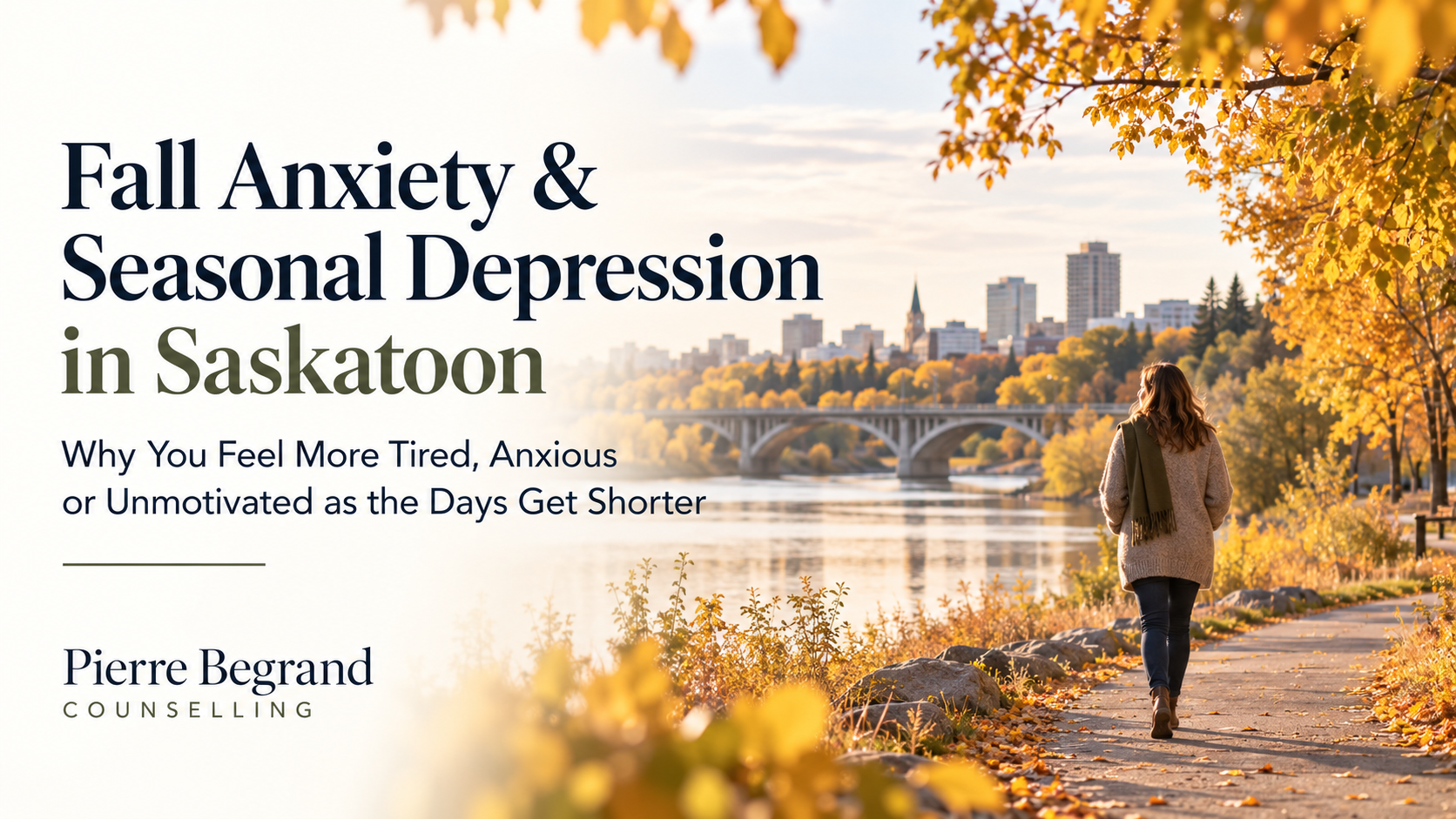
Pierre Begrand Counselling | Saskatoon, Saskatchewan
Fall can be a beautiful time in Saskatchewan.
The air gets cooler. The leaves change. Summer slows down. Routines return.
But for many people, something else changes too.
You may notice that you are more tired than usual, less motivated, more anxious, more irritable, or simply not quite yourself.
Getting out of bed feels harder.
Your workouts become less consistent.
You want to stay home more.
Your motivation at work drops.
You start overthinking things that did not seem to bother you as much a few months ago.
Or maybe there is no obvious problem at all — you just feel heavier.
If this happens to you as fall arrives in Saskatoon, you are not imagining it.
The transition into fall and winter can affect our mood, sleep, energy, routines, social connection, and overall mental health.
For some people, this is a temporary adjustment to a new season. For others, it may be connected to anxiety, depression, burnout, or Seasonal Affective Disorder (SAD).
Understanding what is happening can make it much easier to respond to it.
☀️ Why Can Mental Health Feel Different in the Fall?
One of the biggest changes happening around us in Saskatchewan is obvious:
We begin getting much less daylight.
Seasonal Affective Disorder is a form of depression that follows a recurring seasonal pattern, most commonly beginning during the late fall or winter.
Researchers believe changes in daylight can affect our circadian rhythms — the internal biological processes involved in sleep, energy and wakefulness — as well as systems involving melatonin and serotonin.
Living farther north is also considered a risk factor for winter-pattern SAD because winter daylight becomes more limited.
But you do not need to have Seasonal Affective Disorder for fall to affect you.
The transition can also change the structure of everyday life.
Summer may include more sunlight, outdoor activity, vacations, socializing, movement and spontaneity.
Then September and October arrive.
Work gets busier.
School starts again.
Schedules become tighter.
The weather gets colder.
Evenings become darker.
People spend more time indoors.
Exercise or outdoor activity may decrease.
And sometimes the things that were keeping us emotionally regulated during the summer quietly disappear.
This can make existing stress, anxiety, loneliness, depression or burnout more noticeable.
🧠 Fall Anxiety Is Not a Diagnosis — But the Experience Can Be Real
Some people notice that fall doesn't necessarily make them depressed.
Instead, they become more anxious.
Their mind becomes busier.
They feel pressure to become productive again.
Work stress increases.
There are more responsibilities.
They start worrying about the winter ahead.
Or the slower pace creates more room for thoughts and emotions that were easier to avoid during a busy summer.
Psychologically, transitions can be challenging because human beings generally function better when life contains some degree of predictability.
When routines, light exposure, activity levels and daily demands change at the same time, our normal ways of regulating ourselves may need to adjust as well.
Sometimes the question is not:
“What is wrong with me?”
A more useful question may be:
“What changed around me — and what does my mind and body need from me now?”
That shift alone can reduce a lot of unnecessary self-judgment.
Signs the Seasonal Change May Be Affecting You
Everyone experiences seasonal changes differently, but you may notice:
Feeling more tired or wanting to sleep longer
Difficulty getting motivated in the morning
Lower mood or increased irritability
Losing interest in activities you usually enjoy
Becoming more socially withdrawn
Increased anxiety or overthinking
Difficulty concentrating
Changes in appetite or increased cravings
Exercising less or spending much less time outdoors
Feeling emotionally flat, disconnected or “stuck”
Feeling like ordinary responsibilities suddenly require much more effort
One symptom by itself does not necessarily mean something is wrong.
What matters more is the pattern, intensity, duration, and impact on your life.
❄️ Winter Blues vs. Seasonal Affective Disorder
There is an important difference between feeling a little lower during darker months and experiencing clinical depression.
Many people experience what is sometimes called the “winter blues.”
You might have less energy, dislike the cold, become less active or feel more withdrawn while still functioning relatively well.
Seasonal Affective Disorder is more significant.
SAD is a form of depression in which depressive episodes occur according to a recurring seasonal pattern.
Symptoms may include persistent low mood, loss of interest or pleasure, fatigue, concentration difficulties, changes in sleep or appetite, social withdrawal, hopelessness, or other symptoms associated with depression.
If your mood is significantly affecting your work, relationships, health or ability to function — especially for more than a couple of weeks — it is worth speaking with a qualified health or mental-health professional.
You do not have to diagnose yourself first.
🌱 Your Fall Reset: Build Rhythm Before You Wait for Motivation
One mistake people make when their energy decreases is assuming they need to feel motivated before they start taking care of themselves.
Often, it works the other way around.
Behaviour can help create momentum.
A useful fall reset is not about becoming perfectly disciplined.
It is about rebuilding some of the conditions that help your mind and body function well.
1. Protect Your Light Exposure
As mornings become darker and daylight decreases, be intentional about getting outside during daylight hours when possible.
Even a morning or lunchtime walk can combine several helpful factors at once:
Light + movement + fresh air + a break from screens.
For people experiencing true Seasonal Affective Disorder, clinical light therapy may also be considered.
Light therapy involves specialized bright-light devices and is different from simply turning on more lamps in your house. Speak with a physician or appropriate healthcare provider about whether light therapy is suitable for you, particularly if you have relevant medical conditions or take medications that affect light sensitivity.
2. Give Your Days Some Rhythm
You do not need a perfect routine.
You need a repeatable one.
Try creating a few anchors in your day:
Wake up around a consistent time
Eat regularly
Move your body
Get outside
Create some separation between work and home
Begin winding down around the same time each evening
Our minds and bodies often respond well to consistency.
When everything feels emotionally uncertain, small predictable behaviours can provide stability.
3. Move Before Your Mind Talks You Out of It
When mood drops, people naturally tend to do less.
Unfortunately, doing less can sometimes reinforce the low mood.
This is why behavioural activation is commonly used in cognitive behavioural approaches to depression.
The goal is not:
“Force yourself to be happy.”
The goal is:
“Keep participating in the behaviours that support your wellbeing, even when your motivation temporarily decreases.”
That might mean walking for 20 minutes instead of completing a perfect workout.
Going to yoga even though you would rather stay home.
Getting coffee with a friend instead of isolating.
Small action still counts.
4. Watch the Isolation Loop
Fall can quietly create an emotional loop:
Lower energy → stay home → less connection → lower mood → even less desire to connect.
The longer the loop continues, the more normal isolation can begin to feel.
You do not need to become extremely social.
But maintaining meaningful human connection matters.
Call someone.
Meet a friend.
Join an activity.
Spend time with people who allow you to be yourself.
If you notice yourself consistently withdrawing, become curious about it rather than critical.
Ask:
“Am I resting right now — or am I disappearing?”
There is an important difference.
5. Lower the All-or-Nothing Standard
Fall often comes with a strange pressure to suddenly become productive again.
Summer is over.
Back to work.
Back to routines.
Back to the gym.
Back to goals.
Back to getting everything together.
And if you already struggle with perfectionism, anxiety or self-criticism, that pressure can become another source of stress.
Instead of asking:
“How do I completely get my life back together?”
Try:
“What would make this week 10% healthier?”
Maybe it is three walks.
Maybe it is going to bed 30 minutes earlier.
Maybe it is cooking a few meals at home.
Maybe it is seeing a friend.
Maybe it is finally booking the appointment you have been avoiding.
Mental health usually improves through small repeated choices, not dramatic resets.
💭 Ask What the Season Is Bringing Up Emotionally
Sometimes the season itself is not the whole problem.
It simply makes something underneath more noticeable.
Maybe slowing down reveals loneliness.
Maybe being indoors more often increases relationship tension.
Maybe work exposes burnout.
Maybe the end of summer brings grief about another year passing.
Maybe you start comparing where your life is with where you thought it would be.
Maybe darker evenings give your mind more opportunities to overthink.
This is where counselling can go deeper than simply teaching coping skills.
Instead of only asking:
“How do I stop feeling this?”
We can become curious about:
“What is this feeling trying to tell me?”
That does not mean every emotion contains some hidden profound message.
It means emotions can provide useful information about our needs, patterns, relationships, beliefs and circumstances.
When we become less frightened of what we feel, we have more freedom in how we respond.
When Anxiety Gets Louder in the Fall
For some people, seasonal changes amplify anxiety rather than depression.
You may notice:
Overthinking:
“What if I don't get everything done?”
Catastrophizing:
“This winter is going to be terrible.”
Relationship anxiety:
“Something feels different. Is something wrong between us?”
Performance pressure:
“I need to get my life together.”
Self-criticism:
“Why can't I handle things like everybody else?”
An anxious mind frequently tries to create certainty by thinking more.
Unfortunately, more thinking does not always create more clarity.
Sometimes it creates another loop:
Trigger → anxious thought → body tension → more thinking → stronger anxiety → more attempts to control the feeling.
One of the goals of anxiety counselling is learning to recognize that loop earlier.
Awareness creates the opportunity to pause, regulate and choose a different response.
When Low Motivation Is More Than “Laziness”
One of the most damaging conclusions people make is:
“I'm just lazy.”
Sometimes what looks like laziness is actually:
Burnout
Depression
Emotional exhaustion
Chronic stress
Poor sleep
Disconnection
Loss of meaning
Avoidance driven by anxiety
A mind and body that have been running too hard for too long
Calling yourself lazy does not tell you what is actually happening.
Curiosity does.
Instead of:
“Why am I so lazy?”
Try:
“What is making everything require so much effort right now?”
That question opens a door.
If low mood, exhaustion, disconnection or loss of motivation continues, counselling can help you understand what may be happening underneath it and begin building a healthier way forward.
You Do Not Need to Wait Until Things Become Severe
Many people assume counselling is something you seek only when life becomes unmanageable.
It does not have to be.
People come to counselling because they notice:
“Something keeps repeating.”
“I'm functioning, but I'm not feeling like myself.”
“I can't shut my brain off.”
“I'm exhausted.”
“I'm withdrawing from people.”
“I know something needs to change, but I don't know what.”
Those are enough reasons to start a conversation.
Good counselling is not simply about reducing symptoms.
It can help you understand the pattern underneath them:
What activates you
What happens inside your mind and body
What beliefs or protective responses have developed
What you actually need
Where you may have more choice than it currently feels like you do
🌿 Counselling for Anxiety, Low Mood & Seasonal Stress in Saskatoon
If fall tends to bring more anxiety, low mood, overthinking, exhaustion, loneliness, emotional overwhelm or feeling stuck, you do not have to simply push through the next six months.
At Pierre Begrand Counselling, I provide individual counselling for adults in downtown Saskatoon as well as online counselling.
My approach integrates practical psychological tools with deeper exploration of your thoughts, emotions, nervous system, relationships and repeating patterns.
The goal is not to tell you how you should feel.
It is to help you better understand why you feel the way you do — and develop greater ability to respond to it.
Sometimes feeling better begins with something surprisingly simple:
Understanding yourself differently.
Ready to Talk?
If you are considering counselling and want to see whether working together feels like a good fit, you can book a free 20-minute discovery call.
There is no pressure or commitment.
It is simply a chance to talk about what has been happening, ask questions and determine whether counselling may be helpful for you.
Frequently Asked Questions
Is it normal to feel more depressed in the fall?
Some people experience changes in mood, energy, sleep and motivation as daylight decreases during fall and winter. Mild seasonal changes do not necessarily mean you have a depressive disorder. However, persistent or significant symptoms that interfere with everyday functioning deserve attention.
What is Seasonal Affective Disorder?
Seasonal Affective Disorder (SAD) is a form of depression characterized by a recurring seasonal pattern. Winter-pattern SAD usually begins during fall or winter and improves during spring or summer.
Can fall make anxiety worse?
It can for some people. Changes in schedules, activity levels, daylight, social routines and work demands may make existing anxiety more noticeable. “Fall anxiety” itself is not a clinical diagnosis, but the experience of increased anxiety during seasonal transitions can still be meaningful.
What helps with seasonal depression?
Depending on the severity and individual circumstances, approaches may include psychotherapy, behavioural activation, increased daytime activity, appropriate light therapy and, for some people, medication or other medical treatment.
If symptoms are significant, speak with a qualified healthcare professional about appropriate options.
When should I consider counselling?
Consider reaching out when anxiety, low mood, exhaustion, isolation, overthinking or loss of motivation continues to repeat or begins interfering with your work, relationships, sleep, health or quality of life.
You do not need to wait until you are in crisis.
Do you offer counselling for anxiety and depression in Saskatoon?
Yes. Pierre Begrand Counselling provides individual counselling for adults in Saskatoon and online counselling.
Areas of support include anxiety, chronic stress, depression, low mood, grief, relationship challenges, emotional regulation, life transitions and feeling stuck.
You can begin with a free 20-minute discovery call.
🍂 A Final Thought
A change in season does not mean something is wrong with you.
Sometimes your environment changes faster than your routines, body and emotions have had time to adapt.
Rather than judging yourself for having less energy or struggling more than you expected, become curious:
What has changed?
What do I need more of?
What do I need less of?
And what small choice could help me feel more grounded this week?
You do not have to solve the entire winter today.
Sometimes the healthiest place to begin is simply noticing what is happening — and responding to yourself with a little more understanding.
Mental Health Disclaimer: This article is intended for general education and is not a diagnosis or substitute for individualized medical or mental-health care. If you are experiencing significant or persistent symptoms, speak with an appropriate healthcare professional. If you are in immediate danger, call 911. If you are thinking about suicide or are concerned about someone who may be, call or text 9-8-8, Canada's Suicide Crisis Helpline, available 24/7.